Unconditional Cash Transfers · Africa-Wide

Cash enables what traditional aid often limits: the freedom to choose.

Ootu Fund puts resources directly in people's hands — empowering families to improve wellbeing, adapt to shocks, transform their livelihoods, and shape their own economic futures.

Pre-implementation · Laikipia, Kenya
Model grounded in 200+ UCT studies
Seeking seed & institutional funding
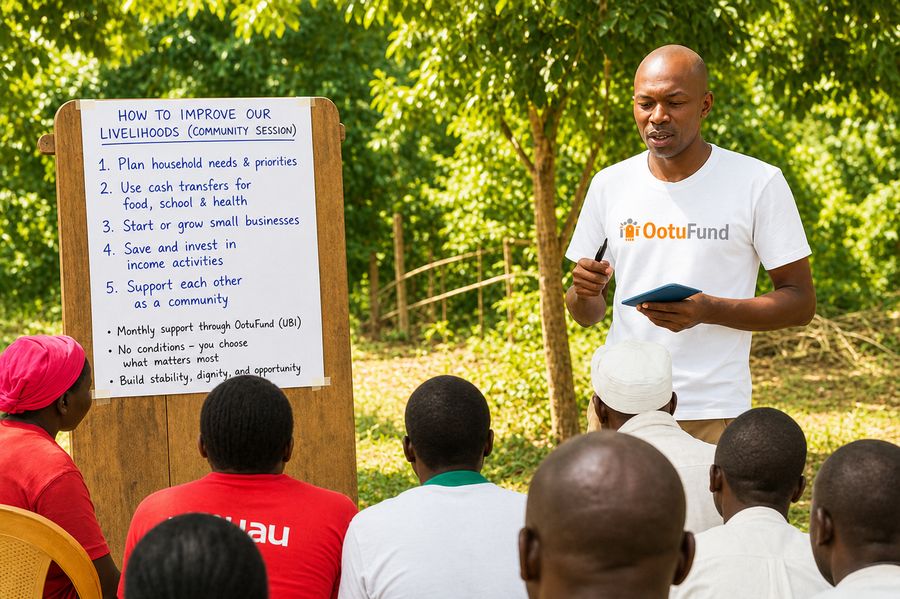
OotuFund facilitator leading a community session on livelihoods and cash transfer program
The Opportunity

Why Laikipia — and why now

The case for OotuFund is built on three pillars: a documented gap, a proven solution, and a team ready to act.

The Problem

Persistent poverty in a high-potential region

36.1% of Kenyans live below the national poverty line, with significantly higher rates in Laikipia's pastoral and peri-urban areas.

Source: Kenya National Bureau of Statistics, 2019

Existing social protection programmes in Laikipia reach fewer than 12% of those eligible, leaving a critical coverage gap.

Source: UNDP Kenya Human Development Report, 2022

Climate shocks — drought cycles and erratic rainfall — are compounding economic precarity for pastoral households at an accelerating rate.

Source: World Bank Kenya Climate Risk Assessment, 2021

The Evidence

Cash transfers: one of development's most rigorous solutions

GiveDirectly's Kenya programme found large, sustained effects on consumption, assets, and psychological wellbeing — with a multiplier effect of $2.60 for every dollar transferred.

Source: Haushofer & Shapiro (2016), Quarterly Journal of Economics

A J-PAL meta-analysis of 37 cash transfer programmes across sub-Saharan Africa found consistent improvements in food security, school attendance, and household asset accumulation.

Source: J-PAL Policy Insight — Cash Transfers, 2022

Kenya's CT-OVC programme demonstrated that unconditional cash reduced child labour by 42% and increased school enrolment significantly in target communities.

Source: Kenya CT-OVC Evaluation — OPM/UNICEF, 2012

The Gap OotuFund Fills

Local infrastructure, diaspora connection, research-grade design

Existing UCT organisations (GiveDirectly, Give Directly Kenya) do not operate in Laikipia. OotuFund is designed to fill this geographic gap with deep local knowledge and established community relationships.

The Kundi platform provides disbursement accountability and MEL data collection that most small UCT operators lack — building funder confidence from the first transfer.

Our Phase 1 target: 200 households in Nanyuki sub-county, Laikipia, receiving monthly unconditional transfers via M-Pesa — designed as a research-grade pilot from day one.

Our approach is grounded in decades of independent evidence

Registered NGO · Kenya NGO Bureau
Model backed by 200+ rigorous UCT studies (J-PAL, GiveDirectly)
Nanyuki, Laikipia County, Kenya
The Science Behind UBI

The evidence for cash is overwhelming

Decades of rigorous research — from J-PAL randomised control trials to GiveDirectly's Kenya programme tracking 20,000+ households — shows that direct, unconditional cash is one of the most effective poverty interventions ever studied. Community members, not institutions, know best how to use it.

Universal

Every enrolled community member in Laikipia receives the transfer — regardless of income, employment, or status. Universality eliminates stigma, reduces targeting errors, and builds community cohesion.

Basic

$40 per month is calibrated to Laikipia's cost of living — enough to cover food, school fees, or a healthcare visit. Not a fortune. Enough to make decisions without crisis driving them.

Income

Regularity matters as much as the amount. A predictable monthly payment — delivered via M-Pesa — lets community members plan, invest, and build rather than simply survive. Certainty is its own resource.

What the evidence shows

Documented outcomes from direct cash programmes in East Africa — verified by independent research

80%+ goes to food, health & education
GiveDirectly Kenya study, 2022
School enrolment rises when cash meets school fees
J-PAL cash transfer meta-analysis
Recipients invest in livestock, tools, and small businesses
Kenya CT-OVC programme data
No evidence of increase in alcohol or "wasteful" spending
World Bank review of 30 UCT programmes
Reduced stress and improved mental health
Financial security removes the chronic burden of scarcity
Cash builds climate resilience in drought-prone Laikipia
Predictable income allows households to adapt, not just survive shocks
Evidence from the Field

What UCT Programmes Achieve: Global Evidence

Documented results from rigorously evaluated cash transfer programmes around the world — the evidence base OotuFund's model is built on.

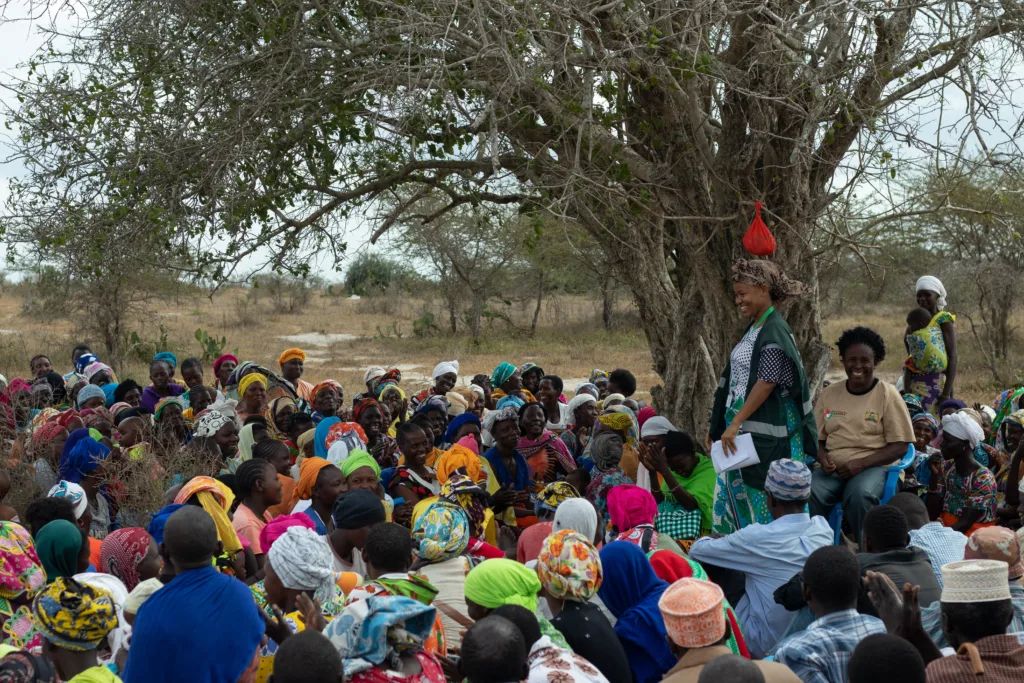
Community members at a GiveDirectly cash transfer programme in Kilifi County, Kenya. Photo: GiveDirectly.
GiveDirectly · Siaya County, Kenya · 2011–2016

A Randomised Controlled Trial of 1,500 households receiving lump-sum transfers (~$1,000) found a 38% increase in food security, a 31% rise in asset values, and a 58% improvement in psychological wellbeing — with no increase in spending on alcohol or tobacco.

Source: Haushofer & Shapiro, American Economic Review, 2016

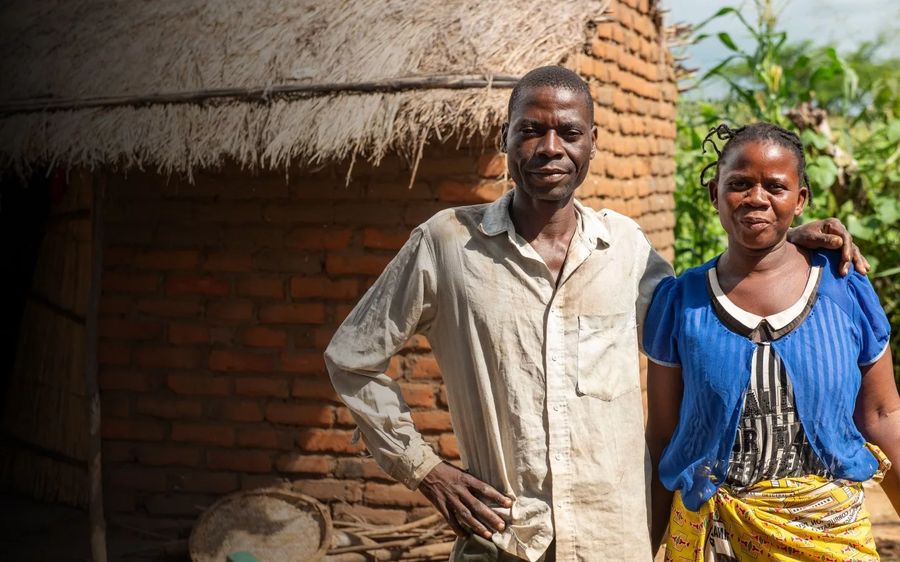
GiveDirectly cash transfer programme community member in Malawi. Photo: GiveDirectly.
Bolsa Família · Brazil · 2003–ongoing

Brazil's national cash transfer programme reached 14 million+ families and reduced extreme poverty by 21 percentage points. Independent research found no reduction in adult labour supply — the "welfare dependency" concern did not materialise at scale.

Source: Soares et al., International Policy Centre for Inclusive Growth, 2010

GiveDirectly Kenya recipient using mobile money transfer. Photo: GiveDirectly.
Novissi · Togo · 2020 (COVID-19 Response)

Togo's AI-targeted mobile money transfers reached 500,000+ people during COVID-19. Evaluators found AI-based targeting was 4–11× more accurate than traditional community-based targeting at reaching the poorest households — a landmark proof-point for technology-enabled UCT delivery.

Source: Aiken et al., Science, 2022

94%
of UCT recipients invest in children's education
GiveDirectly Kenya RCT, 2016
$2.60
returned per dollar transferred (local multiplier)
Egger et al., QJE 2022
42%
reduction in child labour in UCT communities
Kenya CT-OVC Evaluation, OPM/UNICEF 2012

Figures from independent peer-reviewed research on UCT programmes. Not OotuFund's own data.

Partner With OotuFund →
Our Model

How OotuFund Works

No intermediaries. No conditions. Just a rigorous, community-led process that gets cash directly to the people who decide how to use it best.

Step 1

Community Identification & FPIC

We use Free, Prior and Informed Consent (FPIC) — the international standard for genuine community agreement — before any programme begins. Communities choose to participate; we never impose.

Step 2

Enrolment via Kundi Platform

Community members are enrolled and verified through Kundi — OotuFund's own digital platform, meaning "community" in Swahili. Kundi is built for low-bandwidth environments and designed to eliminate fraud and duplication.

Step 3

Monthly Cash Transfer via M-Pesa

$40 arrives directly in each community member's M-Pesa account, every month, with no conditions on how they spend it. No vouchers. No approval required. Just cash — and the agency to use it as they judge best.

Step 4

MEL — Monitoring, Evaluation & Learning

Field officers document outcomes using Kundi. We track spending patterns, household wellbeing, and community-defined goals — not to impose conditions, but to learn and improve. Data belongs to communities.

Read our full Theory of Change
For Institutions & Researchers

Work with us in the field

OotuFund welcomes research partnerships, co-design enquiries, and institutional co-funding arrangements. We operate an open-data MEL framework and can provide IRB-compatible access to programme data.

Send cash home — directly

Diaspora members can channel transfers through OotuFund's verified Kundi enrolment system, ensuring cash reaches the intended household with full accountability and MEL tracking.

Get in touch →

Research & evaluation access

We maintain an open-data MEL framework with household-level anonymised data, spending pattern logs, and wellbeing indicators. We welcome RCT co-design, impact evaluations, and academic collaborations.

Discuss a partnership →

Institutional co-funding

NGOs, foundations, and government agencies can co-fund programme expansion into new Laikipia sub-counties. We provide full financial reporting, community FPIC documentation, and independent audit trails.

Request a briefing →

All partnership enquiries are reviewed personally by our Executive Director. We aim to respond within 72 hours. Write to matu@ootufund.org or call +254 719 812-840.